
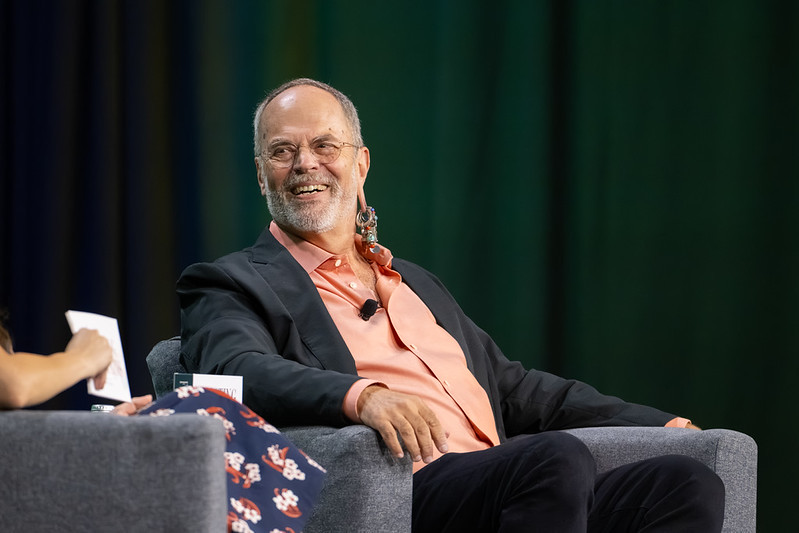
The impact Joe Rohde has had on the Disney company is undeniable and at 2026 D23: The Ultimate Disney Fan Event a special panel took a closer look at his legacy with first-hand accounts of what it takes to make literal floating mountains!
Here’s a look at what we got to see during the Floating Mountains: A Conversation with Joe Rohde panel at the during 2026 D23: The Ultimate Disney Fan Event (formerly D23 Expo) taking place from August 14 – 16, 2026.
Moderated by Lisa Cabello (Senior Manager of Synergy & Fan Engagement for The Walt Disney Studios), the special conversation featured spotlighted the iconic former Disney Imagineer who was ready to talk about his iconic legacy working for the mouse which just so happens to also be the topic for his new book “Floating Mountains.”
Joe Rohde became Disney Legend in 2024, a distinction that he was initially surprised to receive considering his his work being so specifically culturally-focused vs more distinct and traditional Disney castles and animated films. His upcoming book, “Floating Mountains” originated from discussions with National Geographic who had initially proposed a book mimicking his fan-favorite Instagram essays. The concept evolved to focus more on the mechanics of creative collaboration in general. Ever humble, he noted that while society biases toward the “singular genius,” almost all creative work occurs in groups, which ultimately elevates the individual. The fascinating creative guru had many great nuggets of wisdom to share.
Here’s a look some of the highlights from the panel.

Image © Disney. All rights reserved.
Creative Foundations
- Raised by a cameraman father and an actress mother, he was encouraged to embrace creativity at home, avoiding the trap of using art as a rebellion against standard career paths.
- His father would pull him out of school at 4:30 AM to visit the 20th Century Fox Ranch, a 40,000-acre property purchased in 1914 filled with abandoned movie sets.
- With no safety oversight, he freely explored sets for productions like PLANET OF THE APES and Irwin Allen shows like VOYAGE TO THE BOTTOM OF THE SEA, learning the relationship between believable detail and practical illusion at a young age.
- As a struggling student who ran with a rough crowd and failed junior high, he secretly read stacks of library books about history and architecture until 3:00 AM.
- He was sent to Chaminade Preparatory High School for more structure, where a theater teacher recognized him as a visual learner and challenged him to design a set, sparking his design trajectory.
Imagineering Journey
- Working as a teacher, an Imagineering executive visited his classroom on an influential day, told him he was wasting his time, and encouraged him to apply. A year later, Rohde submitted a rudimentary portfolio and secured an entry-level job in the model shop.
- He entered during the “golden age of models” while EPCOT was being built. Unable to craft intricate, tiny mechanisms, he thrived carving rockwork models for the Mexico pavilion, driven primarily by the practical need to keep his job.
- Facing layoffs as EPCOT concluded, he pivoted to full-size production, working on New Fantasyland attractions at Disneyland like Pinocchio’s Daring Journey, Mr. Toad’s Wild Ride, and Alice in Wonderland — leaving hidden Easter eggs that remain today.
- Tony Baxter saved his career from further layoffs by hiring him as a concept illustrator. He “worked on whatever Tony wanted me to work on” which eventually led to early Cambodian temple paintings that would eventually evolve into the Indiana Jones Adventure attraction.
Leadership and Collaboration
- Rohde strongly advocates for a “flat” organizational structure that allows unfiltered information to flow smoothly, providing raw material for creative minds without arbitrary silos.
- He praised Imagineering executive Marty Sklar for constantly walking the floor and visiting cubicles directly, ensuring all team members felt seen.
- During the creation of Disney’s Animal Kingdom (which started with a flat group of just six peers) he intentionally assigned himself subordinate tasks, such as designing a drink wallet or taking direction on film elements. This reinforced that roles are interchangeable and ideas must be defended with evidence, not authority. Let the strongest ideas win out based on their merits, not ranking of the person presenting them.
The Power of Narrative
- Asserts that humans are fundamentally narrative-driven creatures whose brains constantly assemble random, staggered environmental signals into a cohesive story.
- Argues that “theme” is the central organizing principle of narrative, and therefore the best tool for organizing massive human efforts, providing both individual autonomy and clear, unified direction.
- He uses the Hawaiian word “hola” (which he learned on a deeper level during the creation of Aulani) to open be an book; emphasizing the necessity of presenting one’s true self, values, and thought processes before beginning a collaborative relationship.
See it for Yourself
D23: The Ultimate Disney Fan Event takes place in Anaheim from August 14 – 16, 2026.
MORE INFO: Check out all MouseInfo coverage for D23: The Ultimate Disney Fan Event at MouseInfo.com/D23
But Wait, There’s More!
Get the latest updates and coverage across our MouseInfo accounts on TikTok, Twitter, YouTube, Instagram, Threads, Facebook, and BlueSky!


